
Understanding the Health Care Needs of the Deaf Community Through Medical Interpreters

By Chandra Char PhD MPH & Michael McKee MD MPH
Article published in the American Association of Family Physicians on October 2024 https://www.aafp.org/afp/2024/1000/graham-center-deaf-community-health-care-needs
For approximately 500,000 Deaf people in the United States who use American Sign Language (ASL), accessing quality health care is challenging.1 Deaf people are more likely to have been admitted to a hospital in the past 12 months and have a history of chronic illness (e.g., cardiovascular disease, arthritis, HIV, obesity) compared with those without hearing impairment.2,3 Contributing factors include lack of cultural competency, few appropriately trained ASL interpreters, insufficient clinician education, and low health literacy levels.4 Deaf is defined here as people who are culturally Deaf (values, traditions, and norms5,6) and use ASL as a primary mode of communication.
When physicians do not use certified ASL interpreters to communicate, Deaf patients report not understanding medical information relayed to them and physicians lack an understanding of these patients' needs.7 Primary qualitative data were collected to understand the communication and cultural barriers between hearing physicians and Deaf patients from the perspective of ASL interpreters. Purposeful sampling8 was used to recruit participant ASL interpreters in California through the Registry of Interpreters for the Deaf. Grounded theory, a general methodology for developing theory that is grounded in data systematically gathered and analyzed, was used to analyze the transcripts and notes.9 Transcripts were coded for patterns, trends, and outlying responses. Themes were developed based on common codes of transcripts (Table 1). This study offers recommendations to improve communication between hearing physicians and Deaf patients to reduce barriers in health care.
TABLE 1. Main Themes and Direct Quotes From American Sign Language Interpreters
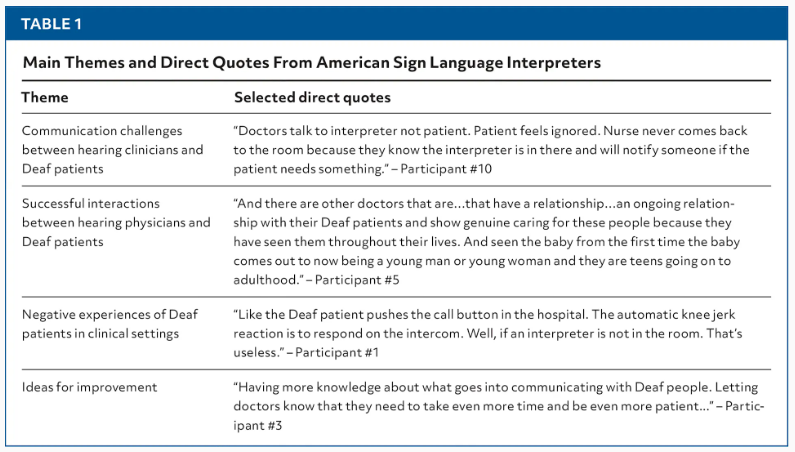
Eleven ASL interpreters (nine female, two male) in California were interviewed individually between January and April 2015. Results of this study highlight communication challenges that occur between Deaf patients and hearing physicians. These results also present ideas for improving communication to enhance the delivery of care for Deaf patients.
Although the interpreters in this study were not exclusively translating in primary care settings, the results can apply to any clinical setting. It is important to provide education to primary care physicians, staff, and administrators on Deaf cultural competency, how to work with interpreters, and the different types of ASL interpreters (e.g., Certified Deaf Interpreters, ASL, signed exact English). Residency curricula should include Deaf patient experiences focused on coursework in diversity, equity, and inclusion. Residency and continuing medical education can also include training on how to utilize ASL interpreters in clinical settings. For example, MCarES Deaf Patient Care Training is a specialized simulation that offers continuing medical education credits for family physicians. Primary care physicians and staff can also follow tips published by the National Institutes of Health to enhance their communication with Deaf patients and use of ASL interpreters. More visual aids can be incorporated into clinical practice to support comprehension of anatomy and diagnoses that may be difficult to achieve with spoken or signed conversation and can particularly be helpful in the absence of an interpreter. Implementing these recommendations could increase effectiveness and efficiency of clinical conversations with Deaf patients.
Thank you to the ASL interpreters who participated in this study for their willingness to share their stories and to members of the hearing loss community who participated in the development of the aims, instruments, and dissemination of this study. Dr. Char thanks her parents, Henny and Narayan Char, for their continual support and encouragement of her research career.
Sources:
1.McKee MM, Barnett SL, Block RC, et al. Impact of communication on preventive services among deaf American Sign Language users. Am J Prev Med. 2011;41(1):75-79.
2.Gopinath B, Schneider J, McMahon CM, et al. Severity of age-related hearing loss is associated with impaired activities of daily living. Age Ageing. 2012;41(2):195-200.
3.Barnett S, Klein JD, Pollard RQ, et al. Community participatory research with deaf sign language users to identify health inequities. Am J Public Health. 2011;101(12):2235-2238.
4.Hommes RE, Borash AI, Hartwig K, et al. American Sign Language interpreters perceptions of barriers to healthcare communication in deaf and hard of hearing patients. J Community Health. 2018;43(5):956-961.
5.Deaf Culture Centre. What is deaf culture? Accessed April 22, 2024. https://deafculturecentre.ca/what-is-deaf-culture/
6.Dolnick E. Deafness as culture. Atl Mon. September 1993. Accessed April 20, 2024. https://www.theatlantic.com/magazine/archive/1993/09/deafness-as-culture/668630/
7.Iezzoni LI, O'Day BL, Killeen M, et al. Communicating about health care: observations from persons who are deaf or hard of hearing. Ann Intern Med. 2004;140(5):356-362.
8.Palinkas LA, Horwitz SM, Green CA, et al. Purposeful sampling for qualitative data collection and analysis in mixed method implementation research. Adm Policy Ment Health. 2015;42(5):533-544.
9.Creswell JW, Poth CN. Qualitative Inquiry and Research Design: Choosing Among Five Approaches. 4th ed. Sage Publications Ltd.; 2018.


Comments